
Hefei Grand Nets Co., Ltd.
Call Us: +86 15605607108
E-mail: sugrand@grandnets.com
WhatsApp:+86 15605607108

- All
- Product Name
- Product Keyword
- Product Model
- Product Summary
- Product Description
- Multi Field Search
Views: 0 Author: SUGRAND Publish Time: 2026-04-21 Origin: Site
2026 has become a challenging year for olive growers in the Mediterranean, North Africa, and Australia: rising costs, labor shortages, and unstable harvests are forcing farms to reassess every piece of equipment. And at the heart of this crisis is the olive net.
At major agricultural forums and grower conferences, one topic has dominated: why low-quality olive nets can cost commercial growers thousands of dollars—and how to address this issue.
Global olive production is surging: the International Olive Council predicts this year's production will increase by 32% compared to last year. But this growth also brings pressure. Large farms and B2B wholesalers now face three significant challenges: the durability of olive nets, their UV resistance, and supply reliability.
Cheap recycled plastic nets tear easily during harvesting; unverified UV-stabilized olive nets degrade within one to two harvest seasons; and supply chain delays mean many growers will miss the harvest entirely.
This article will delve into the hottest debates in the industry, explaining why quality is more important than ever, and showcasing how SUGRAND's premium olive net addresses these pain points for commercial growers.
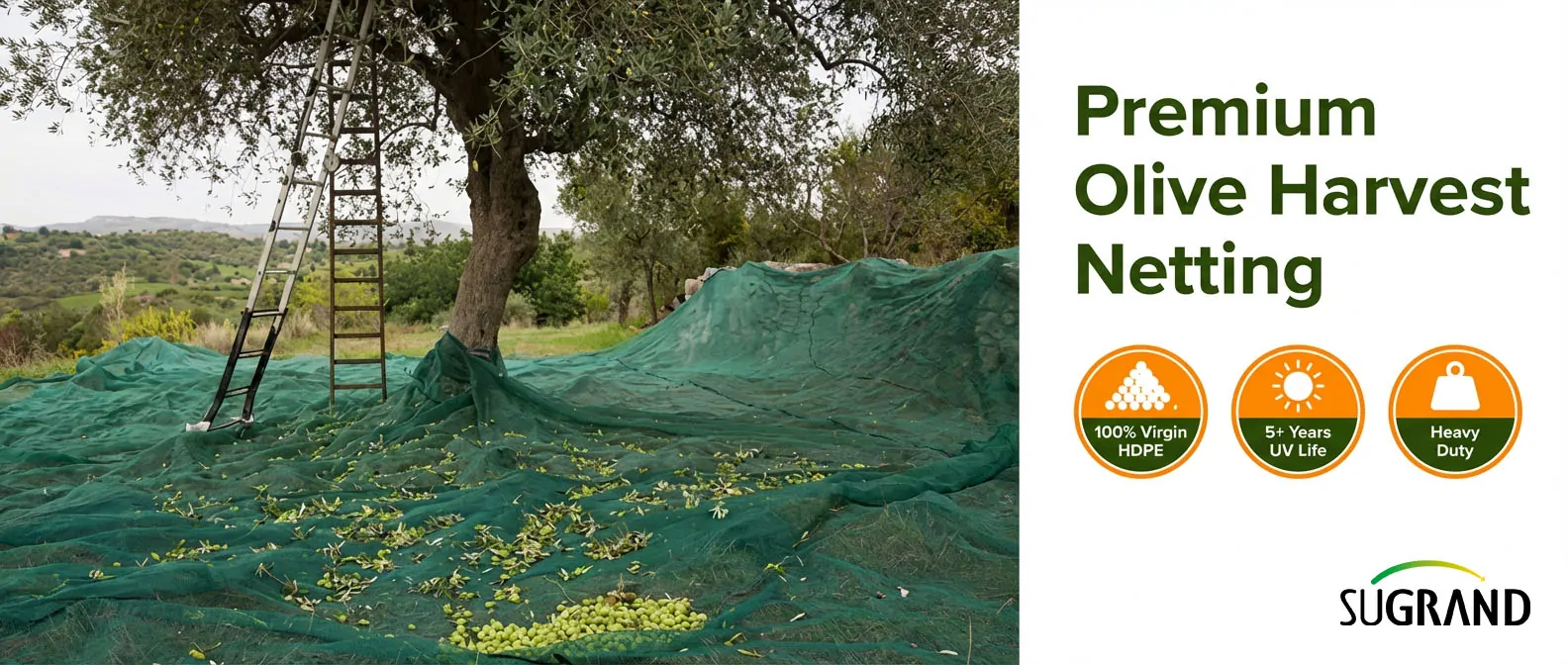
Mechanical harvesting currently accounts for 60% of commercial olive cultivation, but it causes immense wear and tear on equipment. We see many growers sharing shocking experiences: a $500 net tears after harvesting just 10 trees, olives scatter on rocky soil, and workers waste a lot of time repairing holes instead of harvesting.
Why does this happen? Most cheap olive netting uses recycled high-density polyethylene (HDPE) material with low tensile strength. The thin, single-stitched edges are easily worn down or cracked at the seams by the mechanical shaking. Wholesalers report that retailers refuse to accept olives contaminated with soil, forcing growers to lower prices and reduce profits.
Mediterranean and Australian summers mean over six months of intense direct sunlight. However, according to a 2026 industry report, 62% of imported olive nets lack proper UV stabilization treatment.
Replacing the nets every 1-2 years increases operating costs by $2,000 to $5,000 per 100 acres annually. For large farms, this translates to hidden costs reaching six figures. Therefore, while a UV-stabilized olive net with a lifespan of up to five years requires a 20% higher upfront investment, it can save 60% on costs over three growing seasons.
In 2026, 41% of European growers reported waiting 8-12 weeks to receive orders—far exceeding the peak harvest season of October and November. North American wholesalers face similar problems: containers stuck in ports, factories prioritizing large orders over smaller ones, and so on.
Experienced wholesalers have therefore shared strategies such as: “Order 6 months in advance,” “Work directly with factories,” and “Avoid middlemen.”
Cheap olive netting uses blends of recycled plastics—low in strength, inconsistent in quality, and prone to tearing. High-quality olive netting from trusted manufacturers like SUGRAND is made from 100% high-molecular-weight virgin high-density polyethylene (HDPE), which has twice the tensile strength of recycled materials.
Not all UV protection products are created equal. Cheap plastics may have UV coatings, but these coatings are washed away by rain after 6-12 months. High-quality mesh, however, incorporates UV stabilizers directly into the HDPE resin during extrusion, ensuring its protection throughout the mesh's entire lifespan.
SUGRAND's olive netting uses European standard UV inhibitors, preventing fading, brittleness, and cracking, making it suitable for Mediterranean, Middle Eastern, and Australian climates.
Tunisian growers say they have used SUGRAND olive netting for more than seven growing seasons without any damage, saving them thousands of dollars in replacement costs.
Even the strongest materials will fail if the structure is weak. Top-grade olive netting includes the following features:
Double-seamed reinforced edges: prevents abrasion at high-tension points
Aluminum eyelets (rust-resistant): 50cm spacing ensures a secure fastening
Precision mesh: 8-12mm openings that catch olives while allowing leaves to pass through
Standardized roll sizes: 4m/5m/6m/8m width, 100-250m length for easy installation
SUGRAND's design team collaborated with over 80 commercial growers to develop olive netting suitable for practical applications. The eyelets are durable and resistant to loosening. The edges can withstand wind speeds up to 40 km/h.
In a market flooded with low-quality options, SUGRAND stands apart—especially for B2B buyers. Here’s why:
1、Factory Direct Pricing
No middlemen = 20–30% lower costs than European distributors. Bulk pricing tiers for wholesalers.
2、Customization
OEM/ODM services: custom sizes, colors (green/black/white), and branded packaging. Perfect for retailers re-selling under their own label.
3、Strict Quality Control
Every batch tested for: Tensile strength、UV resistance
4、Fast Lead Times
The factory has over 40,000 square meters of production space, and orders can be shipped within 20-45 days.
5、Global Shipping
Container-optimized packaging reduces freight costs by 15%.
For commercial growers and B2B wholesalers, the choice is obvious: invest in 100% pure HDPE, UV-stabilized, reinforced olive netting from a trusted supplier like SUGRAND. Avoid losses due to netting breakage, premature aging, and supply chain disruptions. Protect your harvest, safeguard your profits, and work with a factory that understands your needs.
Contact SUGRAND now for free samples, custom quotes, and bulk wholesale pricing.
Email: sugrand@grandnets.com
WhatsApp/WeChat: 86 15605607108
Address: 15th Floor, B Tower, Jin Zhong Huan Mansion, Hefei, China


